
Behavioral Targeting for Engineers: The Signal Most Electronics Campaigns Never Use
Engineers are difficult to market to, and everyone in this industry knows why.
.webp)
Behavioral targeting for engineers builds a media audience from what engineers actually read, rather than from job titles and company profiles. The signal is a reading trail: which technical articles an engineer worked through, in what combination, and how recently. That trail indicates what someone is working on right now, which is the one thing a firmographic profile cannot tell you.
Engineers are difficult to market to, and everyone in this industry knows why. They avoid sales conversations until they have a specific question. They ignore gated content until they need it. Most of a design decision gets made in datasheets, application notes, forum threads, and comparison articles, long before anyone at a supplier knows the project exists.
What engineers do leave behind is a reading trail. That trail is a usable signal, and it is the one most programs in this space have never had access to.
Key takeaways
- By the time an engineer requests a sample or fills out a form, the shortlist usually already exists.
- Job title and company are stable. Neither changes when a project starts, so neither indicates timing.
- Reading behavior does change. The subject indicates the domain. The pattern and recency indicate the timing.
- EETech's network reaches 8.7 million engineers a month across All About Circuits, Control Automation, and EE Power. A customer data platform categorizes those readers by observed first-party behavior.
- Behavioral targeting is a concentration layer on top of category and audience reach, not a replacement for it.
How much of an engineer's evaluation happens before a supplier hears about it?
Most of it. By the time an engineer contacts a supplier, requests a sample, or fills out a form, the shortlist usually already exists. The parts that made it onto that shortlist were chosen during a research phase that generated no leads, no form fills, and no visible activity on anybody's website.
This is not a failure of anyone's marketing. It is how technical evaluation works, and it has always worked this way. The practical consequence is that programs built to capture demand are working on the back half of a process whose front half is invisible.
Being present during that earlier phase requires a signal that appears while an engineer is still reading, rather than after they have decided to talk to someone.
What does reading behavior tell you that a job title cannot?
Timing. A job title tells you what a person is responsible for. A company tells you what that company builds. Both are genuinely useful, and both are stable, which is exactly their limitation. Neither one changes when a project starts.
Reading behavior changes. An engineer who has worked through a run of articles on motor control, or on thermal management in dense assemblies, or on one specific interface standard, is describing an active piece of work. The subject tells you the domain. The pattern and recency tell you the timing.
Timing is the part that firmographic data structurally cannot provide. An engineer at a company that builds power supplies is a reasonable prospect every day of the year. An engineer reading three pieces this month on gallium nitride switching losses is a reasonable prospect right now. Those are different propositions to a marketer with a launch to support.
Where does the engineering audience data come from?
EETech operates a network of engineering publications, including All About Circuits, Control Automation, and EE Power, reaching 8.7 million engineers a month.
A customer data platform sits across those properties and categorizes readers by the intent and behavior they demonstrate on them. The inputs are first-party and observed rather than purchased or inferred:
- what was read
- how often it was read
- in what combination
- how recently
Engineers who have registered for a webinar, an application note, or a newsletter have also identified themselves directly.
The distinguishing characteristic of this data is not the volume, though the volume matters. It is that the signal is behavioral and current, drawn from technical content that only someone doing the work would sit down and read.
Is observed reading behavior a better signal than stated interest?
For technical content, yes. Observed behavior and stated interest are different quality signals.
A form field captures what someone was willing to select from a dropdown, at one moment, possibly to get past a gate. A reading history captures what that person chose to spend twenty minutes on when nobody was asking.
Nobody reads a thermal derating analysis for entertainment.
Does behavioral targeting replace category and audience buys?
No. Behavioral targeting is additive rather than competitive. Category buys and behavioral buys answer different questions, and a strong program runs both.
Category and audience buys, across newsletters and display, build presence and familiarity across a whole discipline. They are how a brand becomes a name that an engineer recognizes when it appears on a shortlist, and that recognition is built through consistent reach over time rather than through precision in any single week. For most suppliers, that reach is the foundation of the program and should be.
Behavioral targeting answers a narrower question: which engineers are demonstrating activity around this specific product, application, or standard right now. It is a concentration tool, most valuable when there is something particular to push and a reason to weight spend toward the people closest to it.
Category and audience buys vs. behavioral targeting
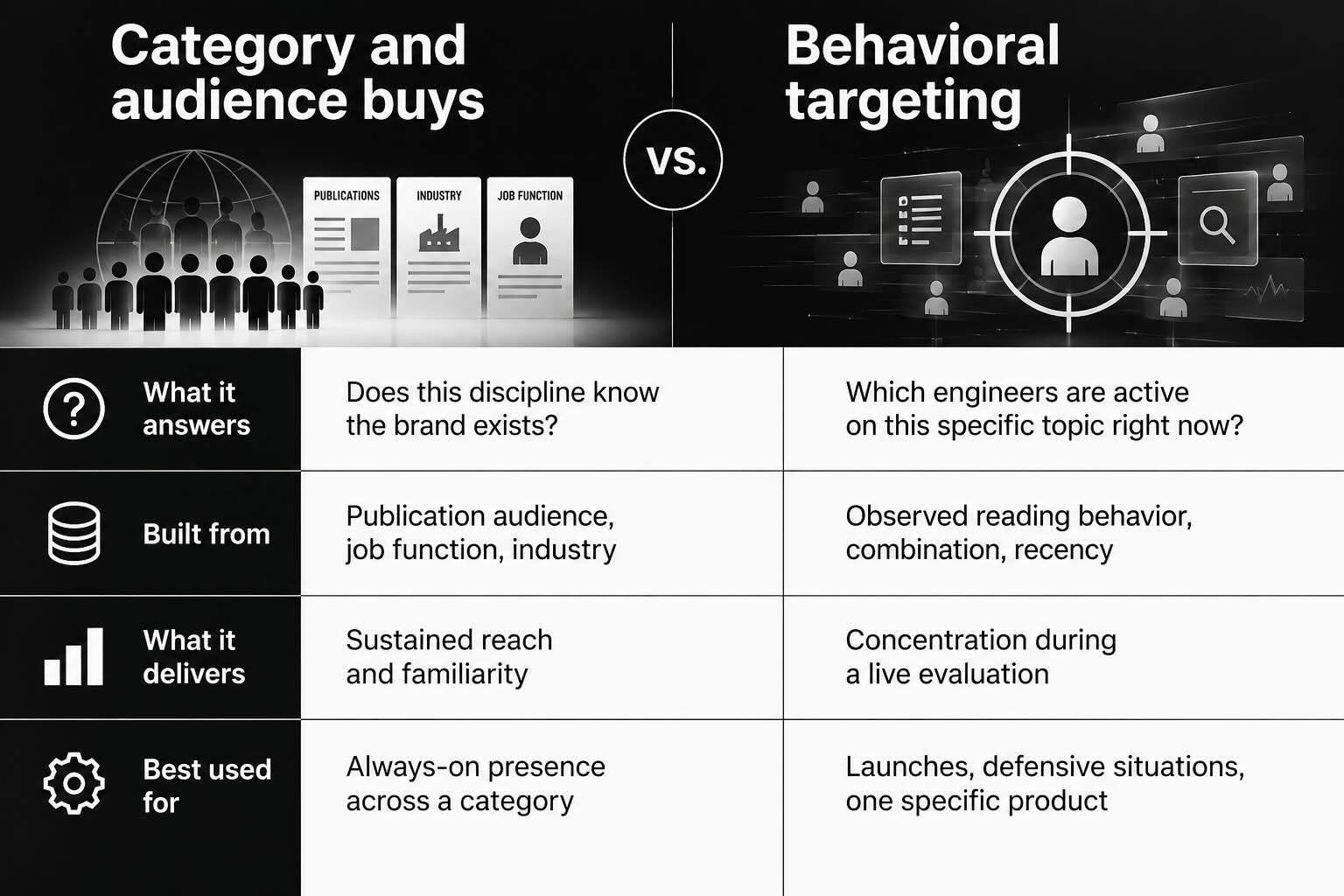
A launch is the clearest case for running both. Category reach establishes that the product exists across the audience that should know about it. A behavioral layer concentrates additional weight on engineers whose reading suggests they are working on the problem the product solves. Neither one substitutes for the other.
How do you prepare to build a behavioral audience?
Get specific about what you are selling, in the terms an engineer would actually use.
Most media conversations open at the level of industry. That is the right starting point for reach. For a behavioral layer, the productive input is narrower:
- the application
- the standard
- the competing part
- the design tool
From there the question worth asking is how many engineers are currently showing activity in that space. It is an answerable question, and the answer tends to reshape the conversation that follows.
Find the engineers already evaluating your category
The engineers evaluating your category this quarter are already reading about it. That activity is observable, and it can be targeted. If you want to know how many of them are out there for a specific product or application, the Audience Size Generator takes your parameters and a NexTarget specialist builds the audience and sends back the numbers.
Find your audience: eetech.com/nextarget/audience-calculator
Frequently asked questions
What is behavioral targeting for engineers?
Behavioral targeting for engineers is media targeting built from the technical content engineers read, rather than from job title, company, or industry. It identifies engineers demonstrating activity around a specific product, application, or standard, and it indicates timing as well as subject.
How is behavioral targeting different from firmographic targeting?
Firmographic targeting is stable. A job title and a company do not change when a project starts, so they cannot indicate that an evaluation is underway. Reading behavior changes with the work, so the subject indicates the domain and the pattern and recency indicate the timing.
How many engineers does EETech reach?
EETech's network of engineering publications, including All About Circuits, Control Automation, and EE Power, reaches 8.7 million engineers a month.
Is this data first-party?
Yes. The inputs are observed on EETech properties rather than purchased or inferred: what was read, how often, in what combination, and how recently. Engineers who registered for a webinar, an application note, or a newsletter have also identified themselves directly.
Should behavioral targeting replace reach-based media buying?
No. Category and audience buys build the familiarity that makes any later message land. Behavioral targeting concentrates weight on engineers active around one specific thing. The strongest programs run both, for different reasons.
What do I need to provide to have an audience built?
A precise description of the product in engineering terms: the application, the standard, the competing part, or the design tool. Industry alone is the right input for reach, but it is too broad for a behavioral layer.
Related articles






Annual Industry Research
Research backed strategy is the key to success. For years, our insights have shaped the industry’s understanding of an evolving customer base. Whether you're targeting the broader electronics industry or specific market segments, our Annual Industry Research provides the comprehensive data and insights you need to make informed strategic decisions.
Don’t worry. We hate spam, too. Sign up for our quarterly newsletter packed with market updates and research insights.
.webp)