
Your Website Isn't a Marketing Problem. It's a Revenue Problem
A direct conversation with electronics industry leaders about the commercial cost of outdated digital presence and why the companies gaining ground right now are thinking about it completely differently.

I've spent the better part of two decades working with electronics component manufacturers in their boardrooms, alongside their sales teams, and increasingly, inside their digital and marketing organizations. And in that time, I have watched one particular conversation play out so many times that I can script it before it starts.
A senior executive (CMO, COO, sometimes the CEO themselves) raises the company's website. They're not happy with it. Engineers can't find products easily. RFQs are slow or low-quality. A new product line launched three weeks ago and it's still not fully live online. The conversation quickly gets handed off to IT or the digital team. Someone mentions an API. Someone else brings up the cost of migration. A vendor gets shortlisted, then debated, then delayed. Six months pass. Nothing changes.
Meanwhile, the engineers who are specifying components for next year's production runs have already moved on.
The electronics industry has a blind spot about its own websites. Not a technology blind spot, but a commercial one. And it is costing companies more revenue than most of their leadership teams realize.
This piece is for the executives in the room who sense that something significant is being missed, but who haven't yet had the conversation framed in terms they can act on. That's what I'm here to do.
The Industry Has Changed. Most Websites Haven't.
Let's be honest about what has happened in the electronics component market over the last decade. The specification process has moved online. Not partly, but fundamentally. The engineer who used to call a distributor rep, or wait for a sample kit to arrive, or rely on a relationship with a field applications engineer, is now doing the majority of their initial evaluation work on a screen before any human contact is made.
EETech's own Engineering Insights Report, which features nine consecutive years of annual data from more than 1,000 working engineers, in partnership with ECIA, tells us exactly how this has played out.
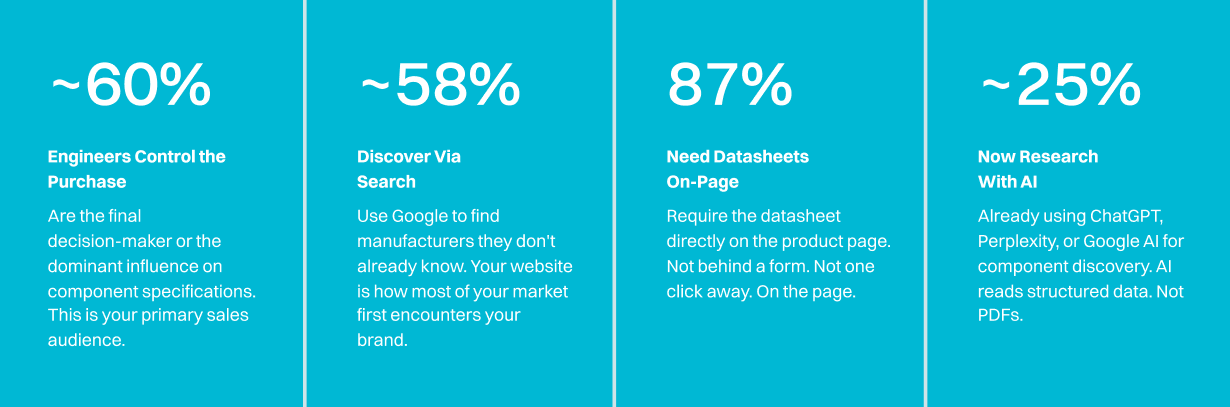
Now read those numbers as a CEO, not a marketer. Three out of five of the people who decide what goes into your customers' products are finding you, or not finding you, through a Google search. Nearly nine out of ten of them will leave your product page unsatisfied if the datasheet isn't immediately accessible. And one in four has already started using AI tools to shortlist components, which means your product data needs to be structured and machine-readable or it simply doesn't exist in those results.
Most manufacturer websites in this industry were not built to perform against any of these realities. They were built to look professional, satisfy a brand brief, and serve as a digital brochure. That was a reasonable design brief in 2012. It is a commercial liability in 2025.
The Losses Are Real. They're Just Invisible.
Here is the thing that makes this problem so easy to defer. The damage doesn't show up on a P&L. No line item reads "revenue lost because our website couldn't filter by propagation delay." No invoice arrives for the design-win that went to a competitor because their product was easier to evaluate online.
But the loss is real. Let me make it concrete.
An engineer is designing a new SiC-based motor drive. They need an isolated gate driver with specific isolation voltage, propagation delay, and output current characteristics. They run a search. They find three manufacturers whose websites have parametric search at the specification level, meaning they can enter their exact requirements and get a filtered result in seconds. Your company also makes a qualifying product. But your website requires them to scroll through a PDF datasheet table to find the same information.
That engineer does not wait. They specify from the three sites that answered their question immediately. Your product never gets evaluated. That design runs in production for five to seven years. The lifetime revenue from that single design-in, across one customer, could be hundreds of thousands of dollars. You lost it before your sales team knew the opportunity existed.
Multiply that by every product category you make, every engineer in your addressable market, every new product launch in the next twelve months. The commercial gap between what your current website generates and what it should be generating is almost certainly the largest untapped revenue opportunity in your business right now.
I am not being dramatic. I am describing what companies that have made the transition to purpose-built electronics platforms consistently discover when they look back at the data six months after launch. Traffic from engineering searches increases significantly. RFQ volume goes up. And the quality of those RFQs, the specificity of the requests, the seriousness of the evaluation behind them, improves dramatically.
Why Your IT Team's Answer to This Problem Is the Wrong Answer.
I want to say something that may create some friction internally, but needs to be said clearly. The people who are best equipped to evaluate this problem commercially are almost never the people who end up leading the decision.
When website underperformance becomes a visible issue in an electronics manufacturer, the conversation almost immediately migrates to IT or the development team. And those teams apply a perfectly rational professional filter. They evaluate solutions through the lens of implementation risk, integration complexity, and maintenance burden. That is their job. They are not wrong to think that way.
But that filter systematically underweights the commercial cost of inaction and overweights the technical complexity of change. The result is evaluations that run for twelve to eighteen months, produce detailed feature comparisons that no one in commercial leadership can evaluate, and default toward the least disruptive option, which is usually staying on the current platform, or commissioning a custom build that will take two years and cost half a million dollars before it generates a single qualified lead.
Both of those outcomes cost the business more than the problem they're supposed to solve. The custom build costs what it costs and then carries eighteen months of opportunity cost while it's being built, during which the current platform continues to underperform. The 'stay put' option doesn't cost anything visible, but it carries the full commercial gap, compounding, every month.
If you are a CMO, COO, or CEO reading this, the most important thing you can do in your next website conversation is insist that the discussion starts with a commercial baseline, not a feature list. What is the current website generating in qualified leads, RFQ volume, and time-to-live for new products? What should it be generating? What is the annual value of the gap between those two numbers? Answer those questions first. Everything else follows.
What Actually Changes the Game and Why It Has to Be Purpose-Built.
I've been in enough platform evaluations to know that the word 'purpose-built' gets used loosely. So let me be specific about what it means in the context of B2B electronics, and why it matters commercially.
A generic CMS (WordPress, Drupal, even Shopify) is built to serve content and process transactions for a general audience. An electronics component website has a fundamentally different job. It needs to answer specification-level queries, not browsing queries. It needs to serve four distinct audiences simultaneously. Engineers who are evaluating, search engines that are indexing, AI tools that are retrieving, and distributor systems that are syncing inventory. It needs to get a new product with all its parametric attributes, technical documentation, and distributor connections, from zero to fully live and discoverable in hours, not weeks.
None of those requirements are on the design brief for a generic platform. They are the entire design brief for EETech Commerce.
What EETech Commerce offers that no generic platform can replicate is not just a feature set, it's a decade of direct research into how the specific audience you're trying to reach actually behaves. The parametric search isn't designed based on what e-commerce search looks like generally. It's designed based on nine years of documented data on how electronics engineers filter and evaluate components. That distinction is visible in commercial outcomes.
But there's another dimension that goes beyond the platform itself and it's the one that most CMOs and CEOs I speak with underestimate until they see it in action.
EETech operates the largest engineering community in the world. All About Circuits, EEPower, Control.com are destinations that millions of engineers visit every month for technical content, product news, and component research. EETech's Datasheets.com platform puts manufacturer products directly in front of engineers who are at the highest-intent stage of the specification process, actively comparing and shortlisting, not just browsing.
When you move to EETech Commerce, you are not simply upgrading your website. You are placing your front door on the street where your entire target market already shops. The commercial consequence of that address changes compounds over time in ways that a standalone website investment, no matter how well-designed, simply cannot replicate.
The Operational Reality That No One Talks About Enough.
There is a dimension of this conversation that rarely surfaces in vendor presentations, but that I hear about constantly from marketing leaders in this industry, which is the developer queue.
On a generic CMS, every meaningful marketing operation requires a developer. Adding a parametric attribute to a product category requires a schema change and a deployment. Publishing a technical article that links directly to a product page requires someone to configure the content type first. When a distributor API changes, as they frequently do, it requires a developer ticket to fix. When you launch a new product family with new technical attributes, it becomes a multi-week project.
This dependency has two costs that rarely get calculated together. The first is the direct cost, which is the developer time spent on marketing operations instead of product development or infrastructure work. The second is the velocity cost, that means every week a new product sits in the development queue for a week and it isn't being found by engineers who are actively specifying right now.
For a manufacturer launching twenty new products per year, with an average three-week online delay per product, you are missing sixty product-weeks of specification opportunity annually. If each week of availability translates to just two evaluation opportunities, at a fifteen percent win rate and a modest fifty thousand dollar lifetime design-in value, that's nine hundred thousand dollars a year in lifetime revenue, from the velocity gap alone.
EETech Commerce is built so that marketing teams operate independently. A new product with all its attributes, documentation, and distributor connections can go live the same day it exists. Your marketing team does it. No ticket. No queue. No missed specification windows.
The Question for Senior Leadership Is Simpler Than It's Being Made.
I've watched too many electronics manufacturers spend twelve months evaluating platforms that should have been a six-week decision. The reason it takes twelve months is not because the decision is complex. It's because no one has established a clear commercial mandate at the leadership level, and in the absence of that mandate, the process gravitates toward technical thoroughness instead of commercial urgency.
The decision is actually straightforward when it's framed correctly. Your current digital presence has a measurable commercial output. There is a measurable target it should be hitting. The gap between those two numbers has an annual dollar value. The investment required to close that gap has a specific cost and a specific timeline. The question is whether the return justifies the investment, and for virtually every electronics component manufacturer I have seen run this analysis honestly, it does, decisively and quickly.
The only way it doesn't is if you exclude the opportunity cost of your current platform from the analysis. Which is exactly what most evaluations do. Don't make that mistake.
The engineers specifying components for next year's production designs are searching right now. They're finding the manufacturers whose websites were built for that search, and they're not filing a complaint when they don't find you. They're simply moving to the next result.
That is the conversation I want to have with you. Not a feature comparison. Not a migration timeline discussion. A direct commercial conversation about the gap between what your current digital presence generates and what it should be generating, and what it will cost your business to close it, versus what it is already costing your business not to.
That's a conversation EETech Commerce is ready to have with you today.
About EETech Commerce
EETech Commerce is the only B2B electronics website platform built from the ground up on research into how engineers discover, evaluate, and specify components. Purpose-built for electronics component manufacturers, it delivers parametric search, structured PIM, technical SEO, frictionless RFQ, and live distributor integration (all marketing-operable, no developer required) within a 6-to-8 week implementation. EETech Commerce connects manufacturers to the world's largest engineering community, including All About Circuits, EEPower, Control.com, and Datasheets.
Related articles



.webp)
.webp)
.webp)
Annual Industry Research
Research backed strategy is the key to success. For years, our insights have shaped the industry’s understanding of an evolving customer base. Whether you're targeting the broader electronics industry or specific market segments, our Annual Industry Research provides the comprehensive data and insights you need to make informed strategic decisions.

Don’t worry. We hate spam, too. Sign up for our quarterly newsletter packed with market updates and research insights.
.webp)