
How a Custom Affinity Audience Gets Built Around a Single Product
The interesting thing about behavioral targeting is not the concept. It is the resolution.
.webp)
A custom affinity audience is built from two signals: documents across a network of engineering publications that contain a defined set of terms, and readers who consistently consume that content. The overlap becomes the audience. The input is either a keyword list or a landing page to derive one from.
The interesting thing about behavioral targeting is not the concept. It is the resolution.
Broad interest data is available in a lot of places. What is less common is the ability to build a live audience around one specific part, one standard, or one design tool, from the technical content engineers are actually reading. That capability changes what a campaign can be pointed at.
Key takeaways
- The most useful input a supplier can bring is the application, the standard, the competing part, or the toolchain, not the industry.
- A custom affinity layer is built from a keyword list or a landing page, then matched against documents in the network and the readers who consume them.
- The audience is only as good as the source library, and technical editorial content keeps it concentrated on practitioners.
- Geography and depth of engagement are the two dials that concentrate an audience further.
- Campaigns stall on creative far more often than on strategy. Six ad sizes plus a headline and description are required.
Start with the product, not the segment
The most useful thing a supplier can bring to this conversation is a precise description of what they are selling and who would use it, in the language an engineer would use.
Not the industry. The application. The standard. The competing part. The toolchain.
A request framed as industrial automation produces one kind of audience. A request framed around a specific interface protocol, or a particular class of sensor in a particular operating environment, produces something considerably more concentrated.
This input determines everything downstream, and it is worth spending real time on before any audience gets built.
What is a custom affinity layer?
A custom affinity layer is an audience constructed from scratch around a defined set of terms, rather than selected from standard interest categories. These are sometimes called context layers.
The input is either a keyword list or a landing page to derive one from. From there the platform works across two signals:
- Documents in the network that contain those terms.
- Readers who consistently consume that content.
The overlap becomes the audience.
A recent build for a widely used PCB design tool illustrates it. The layer was constructed from the product name, related terminology, and the specific tasks engineers perform in the tool, including board layout. The resulting audience is not engineers interested in design software as a category. It is engineers whose reading history indicates they are working in that toolchain now, which is a materially different group and a considerably more relevant one for anyone selling into that workflow.
Why does the source content matter?
An audience built from reading behavior is only as good as what was available to read. The underlying content library does more work here than it gets credit for.
The signal comes from technical editorial and reference material:
- application notes
- design guides
- teardown analyses
- comparison pieces
- standards explainers
That is not general interest content, and it is not consumed casually. Someone working through a piece on switching topology tradeoffs or EMC compliance testing is doing so because it bears on something they are building.
This matters practically for two reasons.
First, a technical library keeps the audience concentrated on practitioners rather than on the broader population of people who follow an industry from a distance. That is a meaningful distinction when the objective is a design decision.
Second, the vocabulary available for building a custom layer is the actual working vocabulary of the discipline, down to part numbers, standards designations, and tool names, because that is the language the source material is written in.
An audience cannot be built around terminology that nothing in the library discusses. The corollary is that the more technically specific a supplier can be, the better this works, which is the opposite of how most audience targeting behaves.
How is an audience concentrated further?
Two more inputs shape a custom affinity audience once the subject is set: geography and depth of engagement.
Geography is the straightforward one, and it is usually a hard requirement rather than a preference. Most suppliers have territories, distribution arrangements, or language constraints that make a global audience the wrong target regardless of its size.
Depth of engagement is the second. Readers can be scored on how consistently and intensively they consume content in a given area, which makes it possible to weight toward the most active rather than treating every reader in a segment as equivalent. This is a useful dial when the goal is concentration rather than coverage, and the practical work of building an audience is finding the setting that best matches the objective.
When is a behavioral layer worth adding to a media plan?
A behavioral layer is not right for every campaign. Two situations are the clearest cases.
A product launch. Category reach across newsletters and display establishes that the product exists, across the whole audience that ought to know. That baseline is doing necessary work and nothing replaces it. What a behavioral layer adds is concentration: additional weight against engineers whose reading suggests they are working on the exact problem the new part addresses, during the window when a design decision is live.
A defensive situation. A competitor releases an alternative to a part you already hold sockets on. Broad reach is not the problem, since the relevant engineers already know your name. The problem is being visible at the moment a redesign gets evaluated. A behavioral layer built around the application, and around the competing product's own terminology, puts the message in front of the engineers actually revisiting that decision.
What does it take to run a behavioral campaign?
The requirements are short, and campaigns stall on the unglamorous items far more often than on strategy.
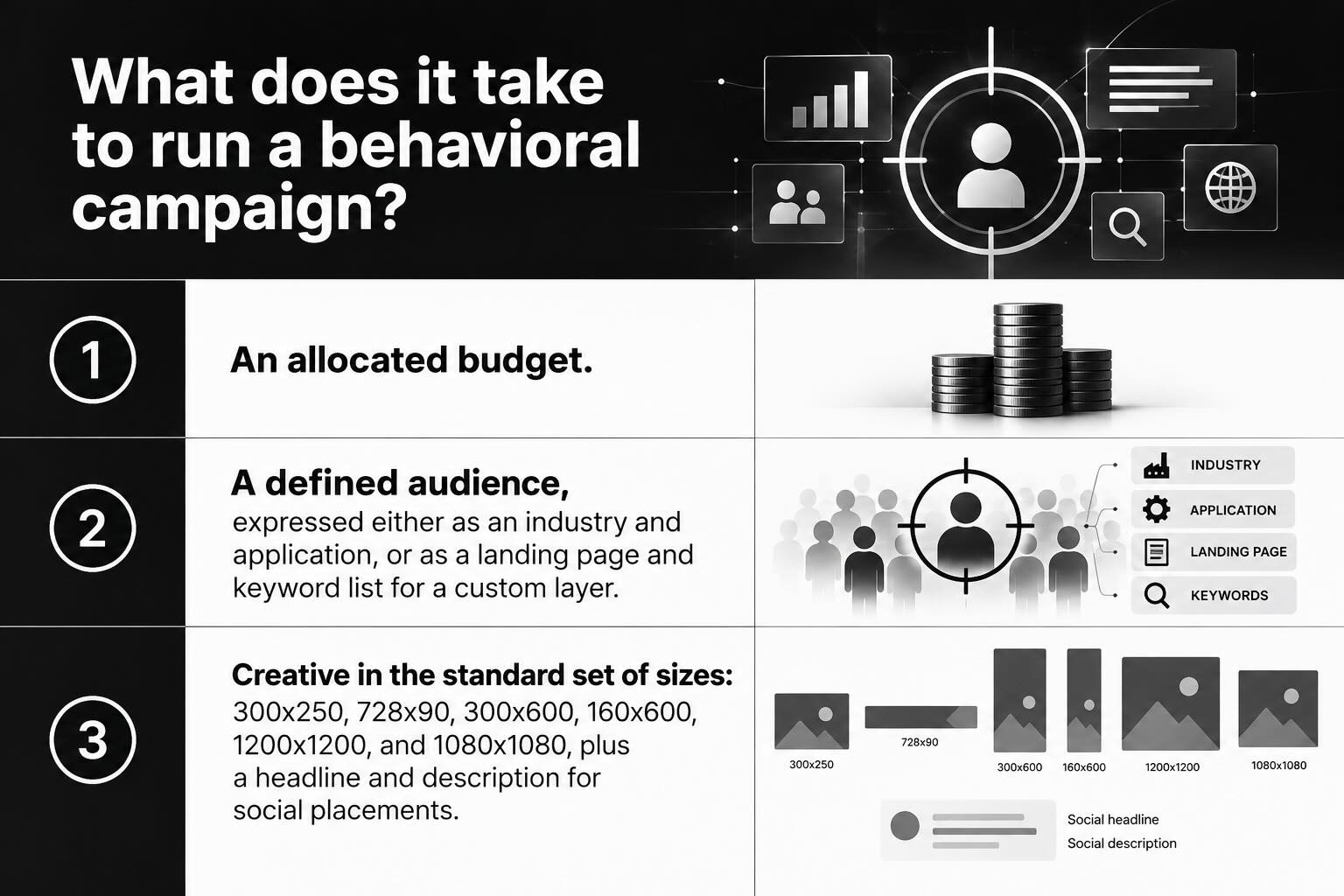
Flag that creative requirement early to whoever produces it. It is the most common reason a campaign that is otherwise ready sits waiting. Everything else in this process moves faster than a design queue.
See what your audience looks like
Category and audience buys build the presence that makes a brand familiar across a discipline. A behavioral layer concentrates weight on the engineers demonstrating activity around one specific thing. Most strong programs run both, for different reasons, and the second question is easier to answer than most suppliers expect.
See what your audience looks like: eetech.com/nextarget/audience-calculator
Frequently asked questions
What is a custom affinity audience?
A custom affinity audience is an advertising audience constructed around a defined set of terms rather than selected from standard interest categories. It is built from documents in the publisher network that contain those terms and the readers who consistently consume that content. The overlap becomes the audience.
What do you need to build a custom affinity layer?
Either a keyword list or a landing page to derive one from. The more technically specific the terms, including part numbers, standards designations, and tool names, the more concentrated the resulting audience.
Can you target an audience around a single design tool?
Yes. A recent build for a widely used PCB design tool was constructed from the product name, related terminology, and the specific tasks engineers perform in the tool, including board layout. The resulting audience is engineers whose reading history indicates they are working in that toolchain now, rather than engineers interested in design software as a category.
How do you narrow a behavioral audience?
Two inputs concentrate an audience once the subject is set. Geography, which is usually a hard requirement driven by territories, distribution arrangements, or language. And depth of engagement, a score for how consistently and intensively a reader consumes content in a given area, which allows weighting toward the most active readers.
What ad sizes are required for a NexTarget campaign?
Six display sizes: 300x250, 728x90, 300x600, 160x600, 1200x1200, and 1080x1080. Social placements also need a headline and a description.
When should you not use a behavioral layer?
A behavioral layer is a concentration tool, so it earns its place when there is something specific to push, such as a launch or a competitive redesign. For building general familiarity across a discipline, category and audience buys do that job better.
Related articles





.webp)
Annual Industry Research
Research backed strategy is the key to success. For years, our insights have shaped the industry’s understanding of an evolving customer base. Whether you're targeting the broader electronics industry or specific market segments, our Annual Industry Research provides the comprehensive data and insights you need to make informed strategic decisions.

Don’t worry. We hate spam, too. Sign up for our quarterly newsletter packed with market updates and research insights.
.webp)