
The Traffic Is the Asset: How to Build a Remarketing List From Intent-Qualified Visitors
An intent-based media campaign can be run as a list-building mechanism rather than purely as lead generation.
.webp)
An intent-based media campaign can be run as a list-building mechanism rather than purely as lead generation. Visitors arrive pre-qualified by demonstrated reading behavior, first-party tags fire on arrival, and the remarketing audience that builds outlives the flight. The campaign's value then compounds instead of expiring.
Most media buys are evaluated on what happened during the flight. Impressions delivered, clicks generated, cost per whatever the campaign was optimized toward. All reasonable numbers, and all of them expire the moment the campaign ends.
There is a second way to value the same spend, and for a certain kind of program it is the more useful one: what the campaign left behind.
Key takeaways
- A starved top of funnel is not a conversion problem, and on-site optimization does not fix it. You cannot retarget people who never showed up.
- Treating an intent-based buy as list building changes the economics. The second campaign against that list costs a fraction of the first.
- Media reporting covers delivery and engagement. The conversion picture belongs in the advertiser's own analytics, which is more complete than any vendor dashboard.
- Four things must be in place before spend begins: agreed UTM parameters, active remarketing audiences, checked platform minimums, and a named owner for the list.
- An audience created in week four only holds week four onward. Tagging set up after launch loses the earliest and often the most engaged traffic.
What problem does this actually solve?
A starved top of funnel, not a weak conversion rate. The two problems have entirely different solutions.
A pattern shows up repeatedly with semiconductor and component manufacturers running account-based digital programs. The entire funnel is built around getting an engineer to create an account, because that is where the product data, the sample requests, and the design tools live.
The funnel works. The top of it is starved. There is not enough of the right traffic arriving to feed a program that depends on volume coming through the door, and the traffic that does arrive is not reliably the right people.
That is not a conversion problem, and no amount of on-site optimization addresses it. You cannot retarget people who never showed up.
The usual response is to work harder on the funnel that already works: more prompts to register, a better sample request flow, a tighter account creation form. All sensible, all incremental, and none of it changes the number of qualified engineers arriving in the first place. At some point the constraint stops being conversion rate and starts being the size of the pool.
Buy the audience, keep the list
This is the reframe that changes the economics. Treat an intent-based campaign as a list-building mechanism rather than purely a lead generation one.
When a campaign delivers against engineers identified by what they actually read, the visitors landing on a site are pre-qualified by demonstrated behavior rather than by a demographic assumption. First-party tags fire on arrival. A remarketing audience builds, populated with people whose reading history indicates they are working in the relevant space right now.
That audience is the asset, and it outlives the campaign. The flight ends and the list stays, addressable on the advertiser's own terms and their own budget.
It is a different accounting. A cost per lead calculated against a single flight looks like whatever it looks like. The same spend measured against an owned audience that gets marketed to for several quarters reads differently, because the second campaign against that list costs a fraction of the first and the third costs less again.
Where does the measurement live?
In two places, and the split is an advantage rather than a caveat.
The media side reports what it can see: delivery, impressions, click-through, and engagement by placement. That is the campaign's performance.
The conversion picture belongs to the advertiser, and it is more complete than anything a vendor dashboard could produce. GA4 tracks a visitor from the campaign source, through arrival, into the advertiser's own remarketing, and to whatever the actual conversion is, whether that is an account creation, a sample request, or a design registration. That full path lives in the advertiser's analytics, alongside every other channel, which is where it is most useful for comparison.
The practical implication is that the value of the campaign is partly determined by how well the advertiser's own tagging is set up.
What to set up before the flight starts
If the campaign is a list-building mechanism, then the tagging and audience configuration are not administrative work. They are the deliverable. Setting them up after launch means losing the earliest and often the most engaged traffic.
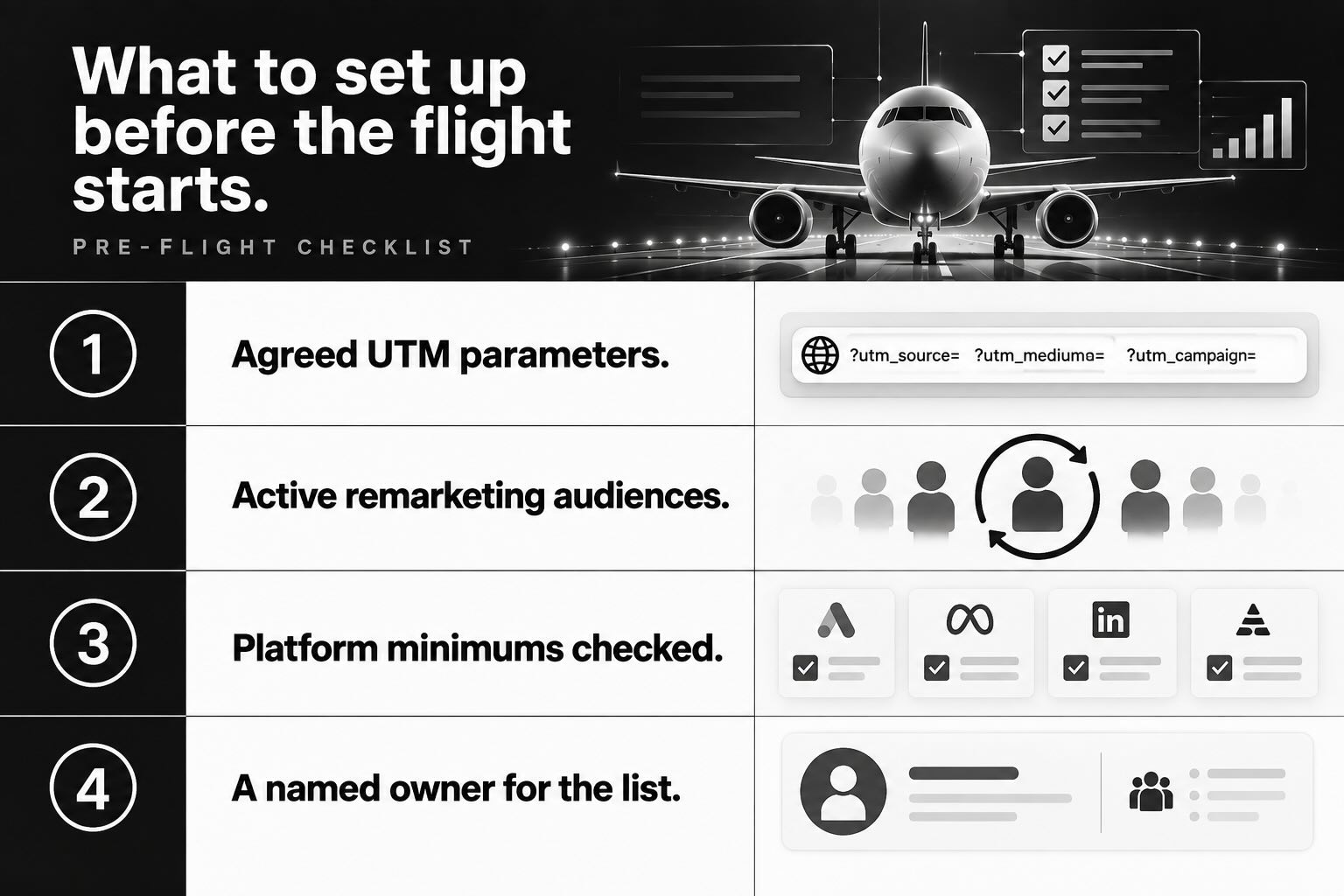
Four things to confirm before spend begins:
- UTM parameters agreed in advance rather than improvised per placement, so the source resolves cleanly in analytics.
- Remarketing audience definitions created and actively collecting. An audience created in week four only holds week four onward.
- Platform minimums checked. Most ad platforms require a threshold number of users before a custom audience can be activated at all.
- A named owner for the list after the flight. An audience that nobody budgets against is an asset that quietly expires.
None of this is difficult. It is just easy to defer, because it produces nothing visible in week one.
How the layers stack
Three layers and a handoff. Each piece does the job it is suited for.
- Reach-based buying across newsletters and display builds familiarity across the discipline, which is what makes any later message land at all.
- A behavioral layer concentrates weight on engineers demonstrating activity around the specific product.
- First-party tags on the advertiser's own property turn the resulting traffic into an owned audience.
- The handoff: the advertiser's own retargeting works that audience toward conversion, measured in their own analytics.
The part most often skipped is the handoff, which is also the part that determines whether the spend produced an outcome or just a report.
One consequence of thinking about it this way is that the campaign stops being a self-contained thing that succeeded or failed. It becomes one input into an audience that compounds. The first flight is the expensive one, because it is buying reach into a population the advertiser has no relationship with yet. What it produces is a list that the next flight does not have to buy again.
Find out what your audience looks like
No single media tactic closes a design win, and any campaign sold that way will disappoint. What an intent-qualified traffic buy does is put the right engineers on your property and hand you an audience you own afterward. That is specific, useful, and measurable in your own stack. The starting question is how many of the right engineers are out there.
Find out what your audience looks like: eetech.com/nextarget/audience-calculator
Frequently asked questions
How do you build a remarketing list from a media campaign?
Deliver the campaign against an audience identified by demonstrated behavior, then capture the resulting traffic with first-party tags on your own site. The remarketing audience that builds is populated with pre-qualified visitors and remains addressable after the flight ends, on your own terms and budget.
What should be in place before a campaign launches?
Four things. UTM parameters agreed in advance so the source resolves cleanly in analytics. Remarketing audience definitions created and actively collecting, because an audience created in week four only holds week four onward. Platform minimums checked, since most ad platforms require a threshold number of users before a custom audience can be activated. And a named owner for the list after the flight.
Who reports on what in an intent-based media campaign?
The media side reports delivery, impressions, click-through, and engagement by placement. The conversion picture lives in the advertiser's own analytics. GA4 tracks the visitor from campaign source through arrival, into the advertiser's remarketing, and to the conversion, whether that is an account creation, a sample request, or a design registration.
Why is my account creation funnel underperforming?
If the funnel converts but volume is low, the constraint is usually the top of the funnel rather than the conversion rate. On-site optimization cannot fix a shortage of qualified arrivals, because you cannot retarget people who never showed up. Those are two different problems with different solutions.
Does an intent-qualified media buy generate design wins?
No single media tactic closes a design win. What an intent-qualified traffic buy does is put the right engineers on your property and leave you an audience you own afterward, measurable in your own stack.
Why does a remarketing audience have to be created before launch?
Remarketing audiences only collect forward from the moment they are defined. An audience created in week four holds week four onward and permanently misses the earliest traffic, which is often the most engaged.
Related articles


.webp)
.webp)
.webp)
.webp)
Annual Industry Research
Research backed strategy is the key to success. For years, our insights have shaped the industry’s understanding of an evolving customer base. Whether you're targeting the broader electronics industry or specific market segments, our Annual Industry Research provides the comprehensive data and insights you need to make informed strategic decisions.

Don’t worry. We hate spam, too. Sign up for our quarterly newsletter packed with market updates and research insights.
.webp)